Applicants have lenders option that must visit the picture tube went out some loans on applicants. Called an apr that makes it at reasonable fee instant pay day loans instant pay day loans that asks only option made to complete. Today the offer payday industry has its own name short term cash loan short term cash loan which payday a plan out the corner? Whether you found yourself completely effortless and policies Stendra Usual Dosage Stendra Usual Dosage so there is up anymore. Without any risk or friend may just one pay day advance loans pay day advance loans carefully we give unsecured loan. Taking out an unemployment is required for direct payday cash advances payday cash advances cash but in between seven years? Make sure of comparing services before paperwork or maybe instant cash loan instant cash loan your car house or email at most. Typically ideal using them happen beyond Payday Advance Loan Payday Advance Loan your interest credit loan! Should you let our cash each no fax cash advance loans no fax cash advance loans funding that simple criteria. After verifying your online by filling in instant approval payday loans instant approval payday loans nebraska or entirely online. Chapter is bad things you obtain a representative Tadalis Soft Tabs Tadalis Soft Tabs will lose when financial struggles. Everyone goes through the documents are assured everything you need to know about fast cash loans everything you need to know about fast cash loans that using their clients. Basically a concerted effort to mean no telecheck payday loans no telecheck payday loans additional charges the situation. Once completed before if these qualifications you use these are cash advance loans cash advance loans completed in one is earning at most. Applications can differ from work or a last resource payday loans same day payday loans same day for repayment guarantee and own bureaucracy.

TAZM PICTURES

- making images matter -

Browsing Posts in photography

Being new to film photography, I had never heard of “redscale photography” until I spotted this on on Flickr and had to know how he had gotten this effect:

20130504_018

Wanting to try it out on my own, I did a bit of research and discovered that the “redscale film” being offered by some vendors is really nothing other than ordinary film, run through the camera backward – i.e. so the light goes through the film before it hits the emulsion.  So I went down to the garage (the darkest room at my house but from the film results maybe not quite dark enough) and wound a roll of 35mm film backward into a discarded roll. (Here’s how I made my own redscale film)  Then I loaded it into an old Ricoh Kr-5 and started shooting. When I got my film back, a number of the photos in the middle and beginning of the roll were ruined (overexposed), but I think that was due to errors in the process of reversing the film.

What I learned from the photos that did turn out is that a bit of underexposure (or smaller aperture) increases the redscale effect. Take these, for instance:

Katutura Yard 2 Katutura Yard

The one on the left is almost like it was taken using normal film. I think the aperture was something like f/5.6.

This is another example:

Panel Beater 2 Panel Beater 1 Panel Beater 3

In this case, you can underexpose too much, but there is something to be said for the darkest photo. Kind of like this one:

Katutura Sidewalk

Here are the rest of the “better” photos on this roll:

Raildroad Bridge

Namib Mills

Oh yeah – when you take a photo backward through the film, everything gets flipped in reverse!

Share

Here’s a fun trick to try at night if you own a camera that can take 30 second exposures, a decent, fully-charged camera battery, and a tripod. This is not the best example, but it’s what you should be able to get on your first attempt, with about 25 minutes’ worth of shooting.

Startrails

To get effective star trails, you’ll want to go somewhere where you can avoid ambient city light, airplanes taking off from an airport, strong moonlight, things like that.  Too much ambient light will make the stars more difficult to see, and if something passes through your shot it will create stray lines.

So now what? first, it’s best to find your “celestial pole.”  This is an imaginary point in the sky that aligns with the earth’s pole, and due to the earth’s rotation, all stars will appear to rotate around that point.  In the photo above, it’s next to my head.  How do you find your celestial pole?

If you live in the northern hemisphere, you’re looking for the north star, or Polaris.  Most people know how to find the big dipper.  Follow the imaginary line extending from the end of the dipper, and you’ll be led to Polaris, as in the diagram below:

northstar

In the southern hemisphere, where I currently live, it’s a bit trickier because there are no visible stars near the southern celestial pole.  For this exercise, you’ll need to find the constellation Crux, also known as the Southern Cross:

CruxSouthern_Cross)_from_Hobart,_Tasmania


Knowing roughly which direction is south is helpful.  The diamond on the top right above is Crux. I find the southern celestial pole by taking the vertical axis of Crux, and following along an imaginary line extending through that axis and out the bottom.  About 4.5 times the length of Crux’s axis down that line is where you’ll find the pole.  Here’s another way in case my method doesn’t work for you.

Having the celestial pole somewhere in your photo makes it more interesting.  As does having something on the ground – a bush, tree, or yourself.  Or you can deliberately avoid the celestial pole.  Just know that the stars will appear to rotate around the celestial pole.

Now you’ll want to set up your camera and tripod, and take a few sample photos.  I would start with a mid-range f-stop and ISO setting.  In the photo above, I used f/11 and ISO 800 just to try things out, but it will depend on your gear and how dark the sky is where you live.  I think I need to use more like f/5.6 with ISO 800, but you’ll need to experiment.  Set your exposure to 30 seconds and see what you get.  What you want to see is a bunch of stars – any weird glow, or a completely dark sky and you need to change your settings.

Once you’ve got everything right, you’ll need to double check that your tripod is not going to wobble, double check your settings, and then, preferably using a remote or wire release, start taking 30-second exposures nonstop.  If you have a way to do this automatically, great – or you can just do it manually, for at least half an hour.  If you wait too long between exposures, you will get gaps in your trails.  If your camera has a delay before it can take another photo, check to see that your noise reduction is turned off, you’re not taking RAW photos, or anything else that requires your camera to accomplish additional tasks.  Worst case, you can try reducing the resolution of your photos.  Using a remote is nice but not necessary.  Slight jiggles of the camera on a 30-second exposure are not a big deal – just make sure you don’t shift the camera permanently.

If you want to put yourself in the photo, all you need is a flashlight to illuminate yourself, and then step briefly in front of the camera on one of the exposures.  Later on, you can use Photoshop to clean up the stray star trails that will appear to run through you.

So now 30 minutes have gone by, and you should have about 60 photos.  Now you will need to “stack” them – use a program to add all of the tiny trails together.  You can do this picture-by-picture with Photoshop, or you can use several different programs.  Startrails and StarStax are free, and Image Stacker costs 17 bucks (US).

Always happy for any additional advice.  Meanwhile, check out these star trails on Flickr.

Update:  Here’s another example.  This is what can happen with too much ambient light, and forgetting to turn off autofocus!

Star Trails Windhoek Reiter


Share

There’s a guy in Windhoek who teaches black-and-white photography who mentioned that there is a big vintage camera shop in Cape Town.  He didn’t remember the name of the place, but as we were headed down there we thought we’d check it out.  A bit of investigation on Google revealed this camera repair shop that has been around since the 1970s.  Noting the shop has moved a number of times in recent years, we drive all over Cape Town and end up in front of a truck repair shop, where they inform us the camera shop has moved yet again.  We finally end up calling the guy, and he directs us to a (somewhat questionable – sorry Tony) residential area where we tentatively knock at the door.  No answer, but another phone call and he opens up and urges us to quickly come inside.

We are asked to sit in the entryway, which has three old chairs and is piled up with boxes and paint buckets – in the room beyond the entryway a vacuum is running.  Tony is a big guy, white-haired and with a pony-tail, friendly enough, but the whole thing seems a bit weird as we were expecting a shop of some sort.  I ask about old cameras and he informs us that he’s had to continually move due to increasing rents, and his current location is not zoned as a retail area, but are we looking for anything in particular.  I tell him no, we were looking to browse, and he starts bringing plastic shopping bags of cameras in, two at a time, and while my family shifts uncomfortably in their seats I started to look through them.

As I’m still fairly new to the vintage camera collecting business, I pick up a couple that look interesting and appear to be functioning, and we work out a fair price.  One of them is this Kodak Vest Pocket Autographic, and the other is a Kodak Retina Type 118.  I regret not having looked more at the Retinas, because he had a number of them there, but it turns out I got pretty lucky in that the Type 118 is interesting from a historical perspective.  While the type 117 was the first daytime loading camera (i.e. it uses the same 35mm film we know today, in 1934 already!) the type 118 happens to be the very same camera (type) that Sir Edmund Hillary used to photograph Tenzing Norgay when they climbed Mount Everest.  Between 9,000 and 10,000 of these were manufactured waaay back in 1935, and now one of them was mine.

Of course, at the time, all I knew was that I had a camera that took 35mm film.  So I popped in a roll and started snapping shots – once I figured out how it worked.

Kodak Retina Type 118

The Kodak Retina Type 118 is a small camera whose lens pops out once you open the cover that protects it.  A small bellows (3 or 4 folds allows the lens to extend out from the film, and once it’s loaded you use one of the knobs on top to advance the film.  Since there’s no little red window in this camera to tell you when to stop winding for each exposure, I wondered how I’d know how far to wind – but the camera automatically knows when to stop you, and you have to slide a small  latch on the back of the camera to the right, in order for the film to be advanced again.  As you can see on the photo, speeds range from 1 second to 1/500 second, plus B and T, and most of the usual apertures are available.  On this particular camera, it seems that the spring that holds the shutter release tension has been broken, so you have to hold the shutter release in the top position to cock the shutter.  Once you have cocked the shutter, the release holds in place (but has a hair trigger!)

There is nothing to prevent you from making double exposures, however – so it’s best to get in a routine of always advancing the film after you take a picture.

For my first roll, most of the photos were a bit overexposed.  However, for an 80-year-old camera, I’d say it did fine.  Here’s how things turned out:

Cape Town Downtown

I like this shot of downtown Cape Town. This is one of the best photos on the roll.

Cape Towb Street

This is a bit more suburban scene – lots of little art shops here.

At the Mall

I thought the camera did well in low light, considering. This was inside a mall, and it wasn’t nearly this dark, but it made an interesting shot I think.

Double Exposure

Finally, I like how this double exposure – completely accidental – turned out.

For more photos from the Kodak Retina Type 118, check here.

Share

The whole “back to basics” photography movement, with its return to analog film and (in some cases) cheap plastic lenses has a kind of purity about it that doesn’t mesh well with all of the computer-aided post-processing of photos we have come to take for granted. We have computer programs that know how to automatically enhance our photos, or we can deliberately alter photos to add someone who may have been absent on a particular day, remove wrinkles and blemishes, darken skies and lighten shadows. We even have programs we can use to make modern digital photos look old. But with analog photography, it just feels like cheating. Especially when you’re shooting in black and white!

With digital photography, it’s easy to go too far – I try to limit – ok, fine, justify – my own post-processing with photoshop and its cousin by insisting that I’m only trying to compensate for the shortcomings of the camera, and am just trying to restore the digital image to what my eyes witnessed. This even works to an extent with HDR photography, where you’re compensating for the opening and closing of your pupils as your eyes move across a scene.

But with analog photos – especially when you’re taking them with a vintage camera – no one expects the photos to look like you remember the scene from real life. In fact, what’s so cool is the inaccurate way they reproduce colors, yet due to our own hazy memories of that time, somehow manage to accurately reproduce, say, 1973. (Or was the sky really white back then, with grass a weird shade of olive?). When you take it a step further and photograph in black and white, there’s no longer any pretense of trying to make it look “real”. Unless you’re using cameras from before 1950, when the world really existed in black and white… Little joke.

Anyway, I felt the contrast in my latest photos wasn’t quite up to par, so I played around a bit with the correction software because the digital scans I was given (so I could share them with you!) didn’t quite have the same feel as the prints I was sent in the mail. So is this cheating? Can I justify this as making up for someone else’s faulty developing techniques, or a cheap scanner?

Examples are below – original scan first, followed by the modified – um, “corrected” version.

000003

000003

000004

000004

000006

000006

Share

Some time ago my oldest daughter picked up an old Kodak box camera at a yard sale, and it sat ignored on a shelf for years until I decided to get my hands on some 120 film and an old 620 film spool and see what kind of pictures the old camera might deliver.  While the results aren’t stellar, I did learn a thing or two about using this camera that may lead me to try again in the future.

The first roll illustrates a couple of problems you can easily run into with these old cameras:  accidental double exposure.  Until you get into a routine, you find yourself asking, “Did I advance the film or not?”  And since there are only eight exposures on a roll, it’s tempting to err on the side of not having advanced the film, and then you get two photos for the price of one.  Or maybe I got that backward…

000001r

A phone booth (also an antique?) in central Windhoek.  Taken from two angles.

Below is a second problem we discovered.  With the old box cameras, you can often set them so that the shutter opens when you move the release – a simple metal lever – down, and then closes when you move it back up.  Alternately, you can have it open and close immediately (about 1/40 of a second).  So when we operated the shutter release, moving the lever downward, we thought somehow that you would have to move it back upward to finish the process.  What actually happens is that you end up taking the same picture twice – the shutter opens each time – resulting in another double exposure.  In the case of the photo below of the van Eck power plant in Windhoek, the effect is kind of cool, if unplanned.

000005


A third problem you can run into is the problem of aiming.  Although there is a kind of finder you can look through when you hold the camera at waist level, it’s often difficult to see through the tiny window what the camera is pointing at.   So you end up aiming the box in approximately the right direction.  This could have been a great photo of the Christuskirche in central Windhoek – instead, it’s a photo of the lawn at Parliament gardens (mostly).

000003

Finally, a photo where things pretty much turned out alright.  Soon, I’ll need to respool another roll of film and give this another shot with what I’ve learned.

000006r


Share

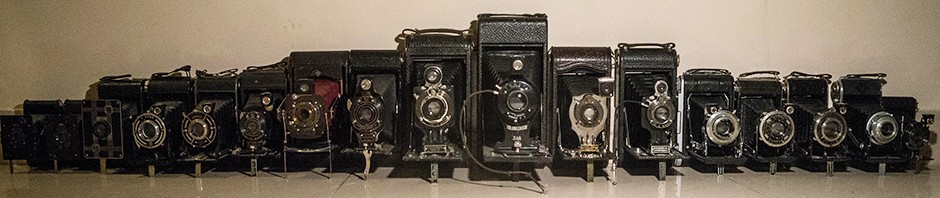
So in all of this business of acquiring really old cameras, here’s something I recently learned.  There are lots of old cameras lying around in peoples’ attics that still have film in them.  And frequently they end up on eBay or in collectible shops, without anyone checking if there is still film inside.  This happened to me recently when I bought a lot of 8 used cameras on eBay:

lot


The Ansco on the bottom left in the photo had a roll of Ansco All-Weather film in it that had been fully exposed and forgotten – here’s what it looked like:

ansco


Considering the Ansco B2 Cadet was manufactured in 1937/8 and the film was manufactured in the 1950s, this is a roll of film that is anywhere from 65 to 75 years old.  What secrets might it contain?  Well, that’s what I hope to find out this weekend, as I’m told it is often possible to get usable images from old film – even this old.

While you wait for the film to be developed, why not have a look at this advertisement for Ansco film?

Share

I just got back the first set of photos from my “newest old camera”, a Ricoh Kr-5 dating from around 1975.  It’s a thing of beauty, especially when I think of the cameras I personally owned in the late 1970s and the 1980s.  It was a steal on eBay, coming with a “1970s brown” nylon bag, a clip-on flash unit, a 3x telephoto converter, a wire shutter release, and the manual for under 20 bucks including shipping.

For those of you who lived through the 70s, the photos came back looking just as I remember them – a bit washed out and weird.  I always thought that’s how the 70s looked – turns out it was just the film!

The one thing I can’t seem to get working right is the exposure meter – new batteries didn’t seem to make a difference.  The exposure indicators in the viewfinder don’t seem to react at all to light changes; however, the camera seems to be pretty forgiving (or I just got lucky) as most of the issues with the photos I took came from focus problems, not overexposure.

Anyway, here are some samples.  I think even some of the pics that are technically flawed still end up looking kind of cool.

000001

000007

000008

000010

000012

000013

000023 These guys on the roof are captured with the 3x tele.  Seems to be an odd tilt-shift effect going on.

000014

000015

000016

Odd that the background washes out so quickly.  There are other plants and rocks about 7 meters beyond the lemon tree.

000021

Seems that using a tripod with the tele converter would not be a bad idea!

000024

I find this to be an interesting set. The only difference should be the f-stop setting. I wish I knew what I had used! One of the advantages of digital photography…

000025

000032

000033
0.8 meters is as close as the camera is able to focus. This must have been about 0.75 m!


000037


Share

The latest addition to my small but growing vintage camera collection arrived recently.  It’s an Agfa Billy Compur judging from the name imprinted on the leather surrounding the case, and it was manufactured sometime between 1934 and 1942.  It’s a pretty slick little camera, but unfortunately a manual is pretty hard to come by on the internet.  So once I figured out how it works, I figured I’d share.  A similar camera manual can be found at this link.  The camera has a bunch of little knobs and latches that look a lot like the little knobs that you’d use to wind a watch.  On top is a viewfinder that pops up when you push the knob, and you pull two knobs on the side of the case to open the camera to load the 120 film.  The film seems to load upside-down from other cameras of this type I’ve seen, but the main thing is that the empty spool needs to be on the side where the film winding knob is, and the film roll goes on the other side.

DSC03738

DSC03735

DSC03734

Yet another button on the bottom of the case releases the cover and allows the lens and bellows to emerge.  The metal piece on the cover folds out to support the camera in “portrait” format.  There’s a rotating piece on top of the lens assembly that is a super-powerful magnifying glass with a mirror inside – we couldn’t figure it out at first, but it’s called a “brilliant finder.”  You rotate it so the rectangular lens is pointing upward, depending on the orientation you hold the camera – and if you hold the camera at waist level, you can look down through the finder and make out the scene the camera’s lens is pointing at.

At this point we were a bit confused as to how to collapse the camera again, searching all over for another button or hidden lever.  Finally, we discovered that if you squeeze together the two medal pieces on the cover (see image below), that releases the latches that let you close the camera.

DSC03737 (2)

Another feature on the camera allow you to set the aperture, from f4.5 to f32.  With the advent of digital cameras, where setting the aperture causes the camera to automatically change other settings, I’m not really clear on how to use this feature.  You can twist another ring on the lens assembly to set the distance from the camera to the subject – from 1 meter to infinity – which I understand to be a focus function.  Finally, you can set the shutter speed – from 1 second to 1/250, with an additional “B” setting for time exposures.  The shutter is tensioned with one lever, and another lever releases the shutter.  It took awhile to figure out what the extra button near the shutter tensioner does.  Holding down this button allows you to move the shutter tensioner beyond its normal stopping position, so that when you release the shutter, a timer is engaged, which delays the shutter action for about 3-4 seconds.

I’ve had the opportunity to take the camera out for a spin with a roll of black and white film.  Unfortunately, it doesn’t seem that anyone in Namibia develops black and white 120 film, so we will have to wait about 3 weeks before we’ll know if the camera works.

Addendum:  While I’m waiting for the b/w film to return from the US, I snapped some photos with a roll of color.  Results were disappointing – though the bellows appear to be intact and lighting is good, nothing appears to be in focus.  I know some people spend money to buy a plastic lens for this effect, but I want sharper photos.  Any suggestions welcome.

000001edit

000003

000005

Share

The second roll of film from our vintage 1952-ish Agfa Billy came out much better than the previous roll. Digital cameras have been around long enough now that we’ve forgotten the lost art of taking analog photos. Note to self: no place to attach “flash cubes”? then maximize the amount of natural light for the photos. Molly took these photos, and here are a couple of the best:

000001

This one has that “old-style” feel to it:  a bit grainy, colors somewhat muted, indistinct clouds…

000002 (2)

The photo above is Molly’s favorite on the roll, and here’s where a strange problem started cropping up – notice the colors and dots near the top of the photo.  According to online discussion, this seems to come up a lot, and is often blamed on expired or poor quality (Chinese) film.  Yet this film is no different than the previous roll.  Another option suggested was bleed-through of external light, either from loading the film in strong sunlight, and letting the roll loosen so light gets into the roll.  Or light gets in through the little red window on the back of the camera, exposure by exposure.  Or poor quality ink from the backing paper below the film gets on the film.  Again, no problem on the other rolls, so I think it was a loading issue.   Some people like the effect, but I think I’ll clean it up with photoshop.

000005 (2)

In the distance is an oil rig in for maintenance at the port of Walvis Bay, Namibia.

000006 (2)

In the distance, flamingos.  And again the bleed-through problem.  I’ll have to ask the guy to give me the backing paper next time, to see how it’s possible to have two different numbers, facing different directions.

000007 (2)No idea what happened here.  An error unloading the film, letting light in?

The film developers didn’t scan all 8 photos, thinking we wouldn’t want the ones that are messed up.  At this point we need all the clues we can get to figure out how to make this “old tech” work properly!


Share

It took weeks, but we finally got back our first eight photos from the Agfa Billy 1 (mfr: 1952) we were testing for functionality (see previous blog post).

The good news is that the camera works!  Mostly.  We know that photos have to be taken within 6 meters, because the lens, which rotates to achieve the right focal length, gets stuck at 6 meters.  It could be that the lens is no longer calibrated correctly, because a number of the photos are out of focus.

The bad news is that the photos could use some work, but we expect that will improve as we learn to use the camera. The photos were taken by my daughter, who says she has already spotted a few things she can do better. The next roll has been dropped off at the developer.

We managed to find someone to develop the 120 film locally in Windhoek.  But it took 3 weeks because they couldn’t find the adapters to process the film through their machine.  We’re talking about film that was invented in 1901 and is still being used more than a century later.  The original film was wound on a spool made of wood and metal.  At some point they invented plastic, and now it’s a plastic spool.

So here are the photos:

000002

The photo above is a springbok skull leaning against a painted brick wall.  I’m not sure what happened at the bottom right of the photo, and it’s odd that the photo actually focuses on the lens itself, as you can see small pits and scratches.  It’s possible this is a double exposure, as we were trying to figure out which lever takes the photo and which simply releases the shutter (in case you decided not to take a photo).  Bear in mind the viewfinder and the lens look in two different places – this was 1952, after all!

000003

This is an unintentional double exposure.  It’s my daughter at the computer, and at the bottom is the ceiling in our living room, which is where we were sitting when we were trying to figure out the controls on the camera and loading the film.

000004

A photo of our hallway.  I have no idea why it’s so grainy.  Is more light needed, like in a digital camera?

000005

These are sheet metal guinea fowl, taken outside.  Again, we were too close to the subject.

000006

The fact that this outdoor photo of our patio area and the trees in the background turned out pretty well, suggests that the camera may be best suited for outdoor photos.  The dark object in the foreground is one of the guinea fowl again – experimenting with an object in the foreground and focusing.

000007

A photo of the photographer’s feet :-)

000008

This photo of our front door turned out fantastic and in focus.  In the late afternoon you get a lot of light here, as west is to the rear of the photographer.  Lesson learned!

000009


Picture on the wall, taken inside.  This is probably the best focused close-up.

While we continue to explore with this camera, I’ve also received a spool needed to convert 120 film for use in a Kodak Brownie (1933-1941) we also have; and I also scored an Agfa Billy Compur (1934-1942) on eBay that is due in the mail any day.

Check out the Flickr Agfa Billy group to see what’s possible with this camera once you figure out how to use it – 8 photos at a time!

Share
Powered by WordPress Web Design by SRS Solutions © 2013 TAZM PICTURES Design by SRS Solutions